 Last night I provided an alternate count for the Market. Should the operative count fail, the alternate becomes our road map. Having both prepares us for any development in the near term. In the overnight session, wave i of wave (iii) ended in a truncated 5th wave. Early action suggests that wave ii is unfolding.
Thursday, July 22, 2010
Elliott Wave Live: Pre Market July 22, 2010
Last night I provided an alternate count for the Market. Should the operative count fail, the alternate becomes our road map. Having both prepares us for any development in the near term. In the overnight session, wave i of wave (iii) ended in a truncated 5th wave. Early action suggests that wave ii is unfolding.

Wednesday, July 21, 2010
Elliott Wave Live: Market Wrap July 21, 2010
Hello Fellow Wavers,
I'm back from a well deserved vacation and I am playing catching up with the e-minis. Tonight's market wrap will be brief but certainly stimulating as I'll offer an alternative wave count to the "herd's" consensus count. So let's dive right in.
 The following chart is the labeling of Elliott Wave Internationals analysts. The current count is wave 3 down. Since third waves are destructive, the price action should have the following personality: a prolonged decline, significant volume, high VIX, and extreme tick lows. You might ask why I am providing this information to you. Well, it is of my subjective opinion that the high of wave 2 (blue, 1127.5) did not mark the beginning of wave 3 down.


I'm back from a well deserved vacation and I am playing catching up with the e-minis. Tonight's market wrap will be brief but certainly stimulating as I'll offer an alternative wave count to the "herd's" consensus count. So let's dive right in.

One could argue the following to support my claim: (see chart below commentary)
Third wave volume should be greater than that of wave 1. Volume was higher in wave 1(blue) and is currently declining rather than expanding. We could attribute this to the summer doldrums but we have seen volatile swings in both directions, yet downside volume has been muted. NYSE total volume ( not shown), exhibits similar traits.
The TICK, as a momentum gauge recorded -934 during wave 1 for the S& P Cash and has failed to take out that low reading during the third wave.
As a measure of fear, the VIX has remained relatively low compared to the "fear" that should occur during a 3rd wave.


Now I'd like to suggest a possible alternative wave count that I feel better explains the most recent price action. From the chart, wave 1 was a "Leading Diagonal", instead of a 5 wave decline. The pattern terminated at 1006. The ensuing retracement ( wave 2, blue) is still unfolding ( see chart). The near term wave pattern from A ( red) appears to be a zig-zag ( 5-3-5). On lower time frames, I can't count a completed 5 wave pattern to complete wave c ( green) of B ( red). In addition, today's daily "Dark Cloud Cover" candle pattern signals continued weakness in the near term. My expectation is for price to test 1042.5- 1040.5 area, whereas, wave c ( green) = wave a (green) at 1042.5, then rally up to 1136 to complete wave 2 ( blue) Thereafter, wave 3 will begin.
So how do we know which count is right?
For the "herd count to prove itself, price MUST decline below well below 1006 and can't exceed 1127.5. These are the lines drawn in the sand. Market internals must reflect that of a 3rd wave personality, i.e. the VIX needs to reflect extreme fear real soon; volume must expand and exceed that of wave 1. Downside momentum, measured by TICK, should reach a new extreme low. If not, the current count, either near term or of the entire decline from 4/26/2010, may be in jeopardy and therefore opens the door to alternative wave counts.
Stay turned.
Best of Trading!
Sunday, July 11, 2010
Elliott Wave Announcement
Hi Everyone,
I will be on vacation from 7/12- 7/20 and will have limited access to the Internet in the mountains of Colorado. Have a great trading week.
I will be on vacation from 7/12- 7/20 and will have limited access to the Internet in the mountains of Colorado. Have a great trading week.
Friday, July 9, 2010
Elliott Wave Live Pre Market: July 9., 2010
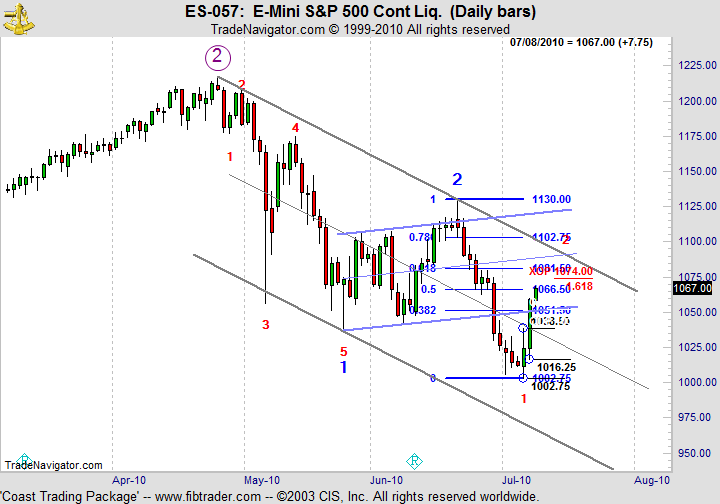
As as reminder, I will be at a conference today but I got up early to post this information so that you can add it to the termination data that was provided in last nights Market Wrap. Please review that post if you already haven't read it. At the daily chart level, wave c= 1.618 wave a at 1074.
Best of Trading
Thursday, July 8, 2010
Elliott Wave Live Market Wrap: July 8, 2010
Note: I will be attending a conference tomorrow so there will not be any pre-market or mid day review.
 Today the market continued it's march higher. After completing wave (iv), prices rallied into the close in what may be wave iii of (v) of c of ii (circle). So my expectation for tomorrow is almost identical as today. Look for a minor decline- followed by a final push up. There are two remaining gaps. One at 1070 which is almost certain to be closed tomorrow since the current wave up doesn't count 5 waves. The other lies at 1082.5 Each are labeled with grey lines.

 Today the market continued it's march higher. After completing wave (iv), prices rallied into the close in what may be wave iii of (v) of c of ii (circle). So my expectation for tomorrow is almost identical as today. Look for a minor decline- followed by a final push up. There are two remaining gaps. One at 1070 which is almost certain to be closed tomorrow since the current wave up doesn't count 5 waves. The other lies at 1082.5 Each are labeled with grey lines.
 There are several wave ii (green) termination points that can now be determined (see attached chart). Once complete, the market should be in a 3rd of a 3rd which should bring prices swiftly below 1006. When wave iii (circle) begins, I'll be watching the market's reaction very closely to see if the price action meets the personality of a 3rd of a 3rd wave. Maybe that's a discussion for the weekly wrap up. Let me know.
Best of Trading!
Elliott Wave Live Mid Day Review: July 8, 2010

Best of Trading!
Elliott Wave Live Pre Market: July 8, 2010
 Good Morning.
Best of Trading!
Wednesday, July 7, 2010
Elliott Wave Market Wrap: July 7, 2010

Last night I also mentioned a potential short trade set up, that didn't materialize... looking for the possibility of a small move up then to new lows ending at wave i (circle). In that statement, stops were above what I'll call "critical resistance" of 1038.5. For those of you who are new readers of my posts, the reason that 1038.5 couldn't be exceeded is that wave ii can't exceed the origin of wave i or I was wrong ( see last nights post for comments and labeling). At the open, prices gaped up and within 1 hour had added 19.75 points to yesterdays close. That was your first warning that an extended move was underway. One that may not be a minor bounce as anticipated. The second clue that a short position was not prudent was the break of the corrective channel lines and the thrusting price action (vertical in nature). Also, if you look at a candlestick chart (not shown) you can see that each bar was long and closing near or at their highs. Another sign of strength. A fourth and final clue that the trade wasn't viable is that prices exceeded the .786 retracement without even a minor pullback. At that point traders should be looking at the alternate count because the likelihood of prices exceeding critical resistance was great.
So the lesson learned is that our wave count is our guide to the anticipated direction of the market. As price unfolds, we must review price in the context of what we expect to occur. When price doesn't confirm or analysis, it's best to stand aside until the wave count resolves itself. If you viewed today's market action with this mindset and accepted what the market offered, a Short was out of the question.
Moving forward, the market seems to be after the gap that closes at 1070.5 that is also located near the previous 4th wave. There is also a gap higher that closes at 1087. We'll have to monitor the wave count as wave c of wave ii progresses to determine is any of these higher objectives can be reached. When wave ii is complete, the next leg down will lead to significantly lower lows.
Best of Trading!
Tuesday, July 6, 2010
Elliott Wave Market Wrap: July 6, 2010

I think tomorrow will provide a good short trade opportunity with stops just above 1038.5 if the current wave up unfolds in only 3 waves.
Finally, I will be at a seminar tomorrow so there will not be any posts until the end of market review.
Best of Trading
Elliott Wave Mid Day Review: July 6, 2010

Elliott Wave Pre Market: July 6, 2010

Best of Trading
Sunday, July 4, 2010
Elliott Wave Weekly Review: July 4,2010
Happy Fourth of July.
As we celebrate our independence here in the US, many forget to reflect upon the significance of holiday events and dismiss the chronological order of events that are significant in history. As a trader, I'm always looking for an edge over the guy on the other side. To see what he doesn't! So before I break out the BBQ and fireworks, I decided I needed to be a historian and study other Bear markets in an attempt to create a working model for future price.
I began my research by reading an article on the Crash of 1929 and the Great Depression. I have taken some excerpts from it and highlighted many similarities to what I believe is unfolding 81 years later. Draw your own conclusions; keep an open mind as the price projections are quite unimaginable to a modern day investor/trader. Remember,stock market crashes are a social phenomena combined with economic events and crowd (the herd) psychology. These patterns repeat but do not always manifest themselves exactly the same.
The October 1929 crash came during a period of declining real estate values in the United States. The psychological effects of the crash reverberated across the nation as business became aware of difficulties in securing capital markets investments for new projects and expansions. Business uncertainty naturally affects job security for employees, and as the American worker (the consumer) faced uncertainty with regards to income, naturally, the propensity to consume declined. The decline in stock prices caused bankruptcies and severe macroeconomic difficulties including contraction of credit, business closures, firing of workers, bank failures,decline of the money supply, and other economic depressing events. The resultant rise of mass unemployment is seen as a result of the crash, although the crash is by no means the sole event that contributed to the depression. The Wall Street Crash is usually seen as having the greatest impact on the events that followed and therefore is widely regarded as signaling the downward economic slide that initiated the Great Depression. (i)
Other Similarities
Wall Street bankers met to find a solution to the panic and chaos. Bids to purchase a large block of shares in "blue chip" stocks were deployed. This tactic was similar to a tactic that ended the Panic of 1907, and are currently being used today by the Federal Reserve and Treasury. History shows that these efforts are temporary at best.
At the time of the Crash, the prospects for passage of the Smoot–Hawley Tariff Act was then being debated in Congress. The Act, proposed the raising of tariff taxes on 20,000 US imported goods. Economists later concluded that the large swings of price prior to Black Tuesday were a result of uncertainty created by the passage of this Act. In my opinion, the Obama Administration's Health Care and Banking Reform bills carry equal weight with investors.
If prosperity defined the "Roaring 20's" as more than just an economic condition, could we not argue that prosperity is a "state of mind? If so, the Crash signified a change in psychology.
Given these similarities and the fact that psychology plays a huge role in financial markets, I decided to use the Crash of 1929 as a working model for the period of 10/2007 to present. From the chart of the cash S&P from 1929-1932, I've compared the magnitude of decline to that of 2007- present.
Magnitude of Decline
1929-1932
So far the analysis has revealed a similar retracement of the b wave. By using the magnitude of decline from 1929-1932 (87%), along with Fibonacci Ratio Analysis we can project the termination of wave c.
If the crash of 1929 ended in a 87% decline, what would a decline of parity be equivalent to today? If wave III ended on 3/2000 @ 1552.87, then wave c would terminate at 201.87. If wave III ended on 10/2007 @ 1576.09 then wave c would terminate at 204.89.
 But is looking at an event of parity realistic, given the parabolic rise from 12/74 to 12/2000? Probably not given that the current waves are 64 times as large! Case in point, parabolic rises produce unsustainable prices at market tops that usually lead to dramatic collapses in the oppositedirection. Another excellent example is Crude Oil (2007 and 2008).
For argument sake, lets look at a 90% decline to see how a few extra percentage points effect the termination points. If wave III ended on 3/2000, a 90% decline terminates at 155.29. If wave III ended on 10/2007, then wave c terminates at 157.61. There may be other multiples of decline that agree with support provided by previous 4th waves but this analysis doesn't take those into consideration. Should they be warranted, they can be addressed at that time.
+Fib+clusters.gif) Conclusions
Conclusions

As we celebrate our independence here in the US, many forget to reflect upon the significance of holiday events and dismiss the chronological order of events that are significant in history. As a trader, I'm always looking for an edge over the guy on the other side. To see what he doesn't! So before I break out the BBQ and fireworks, I decided I needed to be a historian and study other Bear markets in an attempt to create a working model for future price.
I began my research by reading an article on the Crash of 1929 and the Great Depression. I have taken some excerpts from it and highlighted many similarities to what I believe is unfolding 81 years later. Draw your own conclusions; keep an open mind as the price projections are quite unimaginable to a modern day investor/trader. Remember,stock market crashes are a social phenomena combined with economic events and crowd (the herd) psychology. These patterns repeat but do not always manifest themselves exactly the same.
The October 1929 crash came during a period of declining real estate values in the United States. The psychological effects of the crash reverberated across the nation as business became aware of difficulties in securing capital markets investments for new projects and expansions. Business uncertainty naturally affects job security for employees, and as the American worker (the consumer) faced uncertainty with regards to income, naturally, the propensity to consume declined. The decline in stock prices caused bankruptcies and severe macroeconomic difficulties including contraction of credit, business closures, firing of workers, bank failures,decline of the money supply, and other economic depressing events. The resultant rise of mass unemployment is seen as a result of the crash, although the crash is by no means the sole event that contributed to the depression. The Wall Street Crash is usually seen as having the greatest impact on the events that followed and therefore is widely regarded as signaling the downward economic slide that initiated the Great Depression. (i)
Other Similarities
Wall Street bankers met to find a solution to the panic and chaos. Bids to purchase a large block of shares in "blue chip" stocks were deployed. This tactic was similar to a tactic that ended the Panic of 1907, and are currently being used today by the Federal Reserve and Treasury. History shows that these efforts are temporary at best.
At the time of the Crash, the prospects for passage of the Smoot–Hawley Tariff Act was then being debated in Congress. The Act, proposed the raising of tariff taxes on 20,000 US imported goods. Economists later concluded that the large swings of price prior to Black Tuesday were a result of uncertainty created by the passage of this Act. In my opinion, the Obama Administration's Health Care and Banking Reform bills carry equal weight with investors.
If prosperity defined the "Roaring 20's" as more than just an economic condition, could we not argue that prosperity is a "state of mind? If so, the Crash signified a change in psychology.
Given these similarities and the fact that psychology plays a huge role in financial markets, I decided to use the Crash of 1929 as a working model for the period of 10/2007 to present. From the chart of the cash S&P from 1929-1932, I've compared the magnitude of decline to that of 2007- present.
Magnitude of Decline
1929-1932
- The total decline from 1929-1932 was 87%.
- Wave b retraced 61.8 % of wave a.
- Wave a and b are 64 times greater in magnitude as their counterparts in 1929-1932.
- Wave b retraced 61% of wave a.
- Total decline - still unfolding
So far the analysis has revealed a similar retracement of the b wave. By using the magnitude of decline from 1929-1932 (87%), along with Fibonacci Ratio Analysis we can project the termination of wave c.
Fibonacci Ratio Analysis
The following information represent termination points of wave c using an expanded flat interpretation or the alternative count, a zig zag, not show, whereas III, purple, circle ended where b, green is designated and 1 is a and 2 is b). See chart below. The calculations are:
The following information represent termination points of wave c using an expanded flat interpretation or the alternative count, a zig zag, not show, whereas III, purple, circle ended where b, green is designated and 1 is a and 2 is b). See chart below. The calculations are:
Expanded Flat:
- wave c=.618 (wave a) past wave a @299.58
- wave c= .618 wave a @ 283.97
- wave c =1.618 wave a @307.19
Zig- Zag:
- wave c= wave a @ 310.5
- wave c=.618 (wave a) past wave a @ 104.84
- wave c= .618 wave a @ 657.85
- wave c =1.618 wave a @ (251.45) - excluded negative number
If the crash of 1929 ended in a 87% decline, what would a decline of parity be equivalent to today? If wave III ended on 3/2000 @ 1552.87, then wave c would terminate at 201.87. If wave III ended on 10/2007 @ 1576.09 then wave c would terminate at 204.89.

For argument sake, lets look at a 90% decline to see how a few extra percentage points effect the termination points. If wave III ended on 3/2000, a 90% decline terminates at 155.29. If wave III ended on 10/2007, then wave c terminates at 157.61. There may be other multiples of decline that agree with support provided by previous 4th waves but this analysis doesn't take those into consideration. Should they be warranted, they can be addressed at that time.
+Fib+clusters.gif) Conclusions
ConclusionsThe following chart shows bands of support drawn from my research. Use them as a general guide as price structure continues to unfold. As in any long term analysis, these projections will play out over years, not months. Certain events may force us to change or reconsider our viewpoint and strategies. When and if applicable, I will do so.
Best of Trading!
Friday, July 2, 2010
Elliott Wave Market Wrap:July 2, 2010
 There is very little to review tonight based upon today's uninspiring session. I have made one minor change to my early morning wave count to account for the possibility of an alternate wave count. In accounting for this change, I also changed the subdivisions that seem to be a better fit heading into Tuesday's session based upon today's price action. Neither change negates that the fact of the larger trend is down which has been consistent throughout.
 Best of Trading!
Elliott Wave Live Mid Day Review: July 2, 2010
Trade is sideways as traders are probably already hitting the beaches for the holiday. Trade challenged the 1030.25 level that I referred to in last nights post, then turned minimally down . As long as trade remains lethargic, it's best to stand aside.
Best of Trading!
Best of Trading!
Elliott Wave Pre Market: July 2 , 2010

The market remain little changed in the overnight session. With the anticipated jobs report due out at 8:30 am est., traders are not committing. One note of interest. Should (B) 1019.75 hold and the jobs report not tank the market , the corrective rally that I spoke about in last night's "Market Wrap" might just play out between 1041.75 - 1055.25. As you know, corrective waves typically terminate at the previous 4th wave of one lesser degree. So the current wave count offered may be correct as long as key support isn't breached. Please review last nights post for details on support and resistance and more detailed comments.
Thursday, July 1, 2010
July 1, 2010 Market Wrap
 For tonight's daily wrap up I thought that I would revisit a few charts that I posted earlier in the week to illustrate how they fit within the current price structure. The weekly chart hit a significant support area today at 1006 and is beginning to bounce. We may have seen the termination of wave 1 of 3 today on a daily basis.
If you recall I mentioned that I would get really excited if the daily price action could confirm 5 waves down and a three wave counter trend move to complete wave 2. It is uncertain whether the market can challenge previous pivot lows of 1 (blue) at 1036.75 or B (red) at 1041.25. A .382 retracement would fulfill the minimum requirements for a 2nd wave retracement. However, most typically, wave 2's are deep retracements of (.5-.786), with a .618 most typical. A break of 1041.25 would indicate that a larger counter trend move was unfolding. So caution is still warranted at this critical level. I've draw in a proposed 3 wave move in blue ( not to scale in terms of time), just to give a visual aid to what the price structure would look like if the market can break 1041.25. Just focus on the level and identifying three waves up to complete wave 2. Any break below 1006 implies that wave 1 (blue) isn't complete.
Big picture - Since this is a 3rd wave there can be no assurances as to the measurement of the markets mood. Fear and panic will set in in a 3rd wave of a bear market, as those who recovered some of their losses from 2007 will quickly realize that they won't get back to even and be forced to sell or lose even more.
Best of Trading
July 1,2010 Pre Market Call - Follow Up
 A winning trade! In my Pre market call I wrote, "short sellers should be looking for the termination of a three wave structure either in the pre-market or in the regular session to posture ourselves short for another move down". Here's the continuation chart for your review. By 10:00 am est, the e-mini completed an ABC corrective pattern whereas wave c= wave a at 1028.75. Prices exceeded this level slightly as I believe that larger market participants were gunning for the nest of stops just above 1027.75. After cleaning up the floor, the market resumed its previous downtrend to the tune of 23.75 points per contract.
 How to subscribe to my blog
Readers often visit a blog and enjoy it but either fail to return or find it to cumbersome to visit the site on a daily bias. Here's a solution. You can subscribe to the blog using RSS feed located at the top left hand column of the blog.
Enjoy
Enjoy
Why become a follower
Is this your first visit or are you a repeat visitor? If you want to let me and other readers know that you are a fan, there are several ways to become a follower of my blog. One of the easiest ways is to click on the "Follow" button at the top left hand of the navigation bar or under the "Followers" widget in the left side margin: For more details you can visit: http://www.google.com/support/blogger/bin/answer.py?hl=en&answer=104226
I hope you find my blog enlightening.
Best of Trading
I hope you find my blog enlightening.
Best of Trading
Elliott Wave Pre Market: July 1, 2010
 Good Morning.
Often, when the market throws us a curve ball and forces us to re-evaluate our wave count, I like to remove all labeling from my chart and focus on waves in isolation rather than as a whole. In doing so I can still find high probability trade setups and let the market resolve the count for me as more price data is filled in on the charts from the right. Let's take a look.
Best of Trading!
Subscribe to:
Comments (Atom)